Enterprise Resource Automation Pipeline
End-to-end automation framework for real-time inventory alerts
IKEA's operations team managed uniform distribution for **10+ departments** through a fully manual process — employees submitted requests via email or in-person, managers tracked approvals on paper, and HR compiled distribution lists in Excel. There was **zero real-time visibility** into stock levels, leading to frequent stockouts, over-ordering, and a reactive procurement cycle that wasted both time and budget.
Synthesizing User Needs
Understanding the stakeholders through research
To design an effective solution, I conducted stakeholder interviews and synthesized two distinct user archetypes representing the core needs and pain points.
A streamlined, automated uniform distribution process with full visibility into stock levels and employee requests.
- Compiles weekly distribution lists manually from emails and paper forms.
- No real-time view of current inventory — frequent stockouts discovered too late.
- Spends 3+ hours weekly chasing manager approvals via email threads.
Data-driven visibility into uniform consumption to optimize the CAD 60K annual procurement budget.
- No analytics on consumption patterns — procurement is purely reactive.
- Cannot identify which departments over-order or under-utilize uniforms.
- Budget approvals are based on guesswork rather than historical trends.
From Data to Dashboard
A systematic approach to building the solution
Data Pipeline Architecture
How the data flows from source to insight
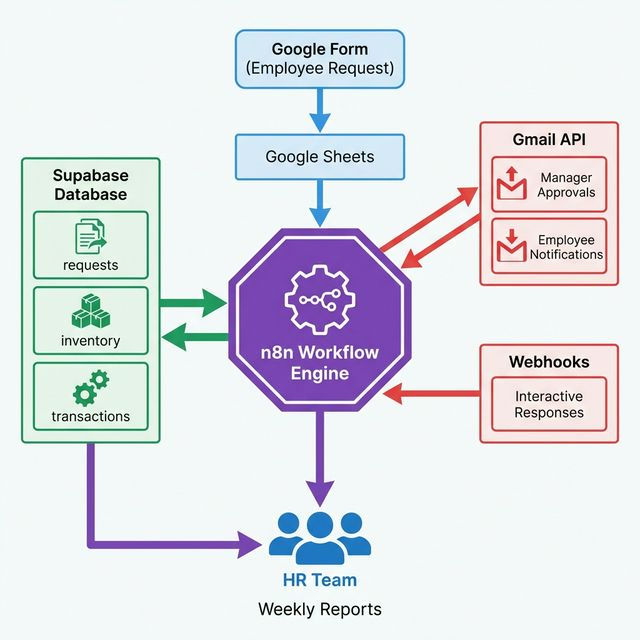
The architecture follows an event-driven ELT pattern: employee requests trigger n8n workflows that validate inventory, route approval emails via Gmail API webhooks, and load structured data into Supabase (PostgreSQL). A transactions table captures granular event logs enabling downstream analysis in Tableau for budget optimization.
Automating the Pipeline
From manual requests to real-time analytics
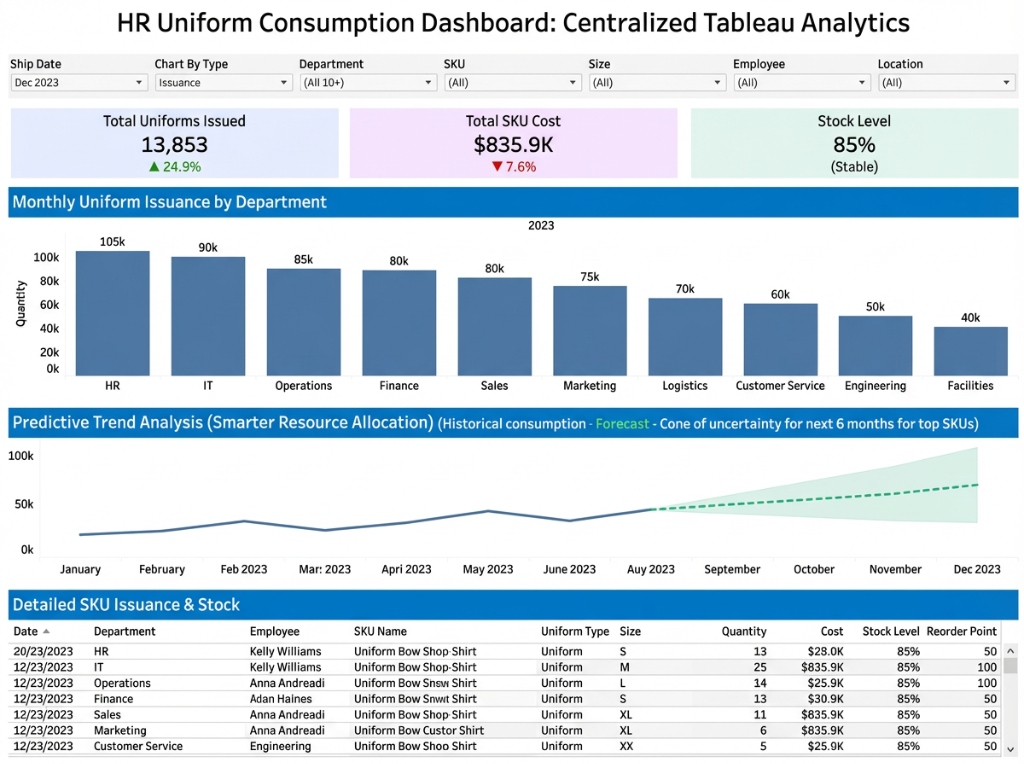
A centralized Tableau analytics suite monitoring uniform consumption patterns across 10+ departments — tracking issuance by department, SKU distribution, monthly trends, and stock levels to enable data-driven procurement decisions.
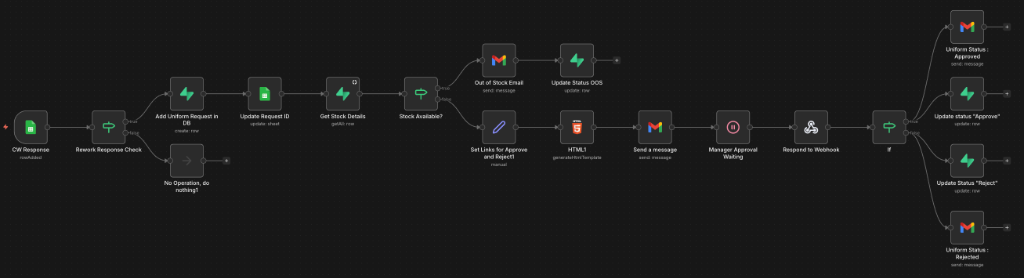
n8n workflows validate inventory in real-time at the point of request — automatically routing out-of-stock notifications or manager approval emails with interactive webhook-based accept/reject buttons.
The event-driven architecture routes requests through Google Forms → Google Sheets → n8n → Supabase, with Gmail API handling manager approvals and employee notifications — eliminating all manual coordination.
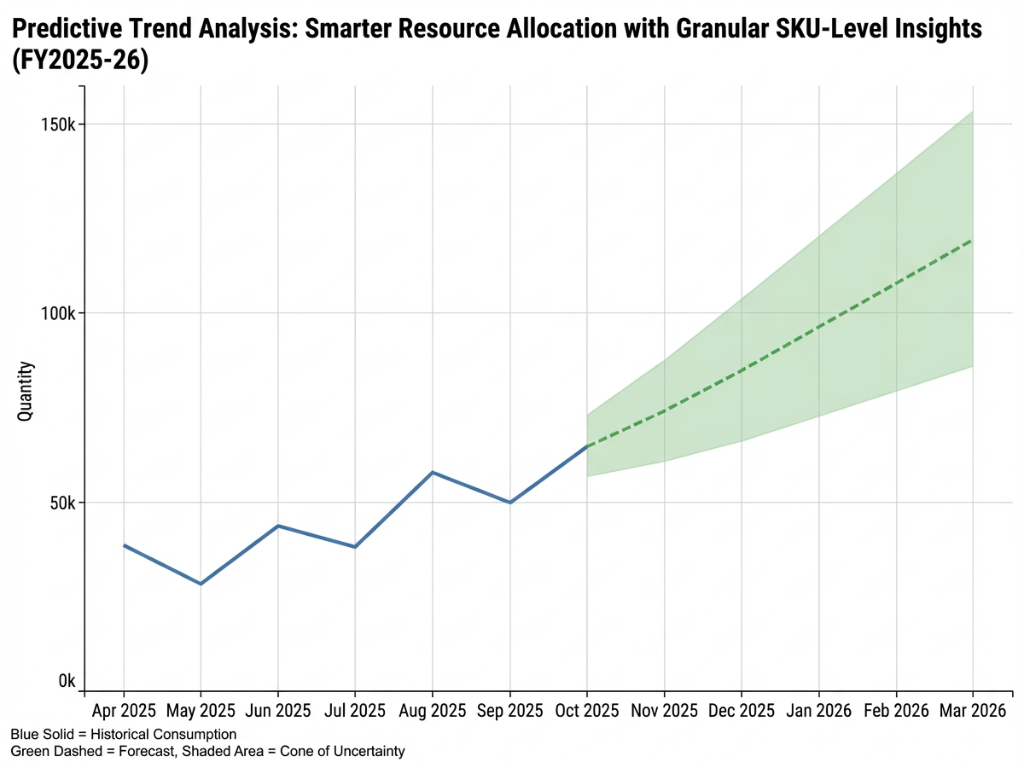
Predictive trend analysis from the Tableau dashboard enabled smarter resource allocation, with granular SKU-level insights replacing guesswork-based procurement cycles.
Outcome & Learnings
Reflecting on what was built and what comes next
Delivered a fully automated uniform management pipeline that eliminated manual coordination across 10+ departments, achieved 100% stock availability, and provided leadership with real-time analytics for budget decisions.
Event-driven architecture with n8n proved ideal for multi-stakeholder approval flows. ACID-compliant transactions in Supabase were critical for preventing negative inventory states in concurrent request scenarios.
Expand to multi-location inventory support with cross-store transfers. Integrate AI-powered size recommendations based on historical fit data. Add Slack/Teams integration for approval notifications.